Most mosque carpet designs belong to one of three families: a saff row design with repeating prayer rows, a center-medallion design built around one large motif in the middle of the hall, and a prayer-arch design that frames every place with its own arch. All three keep worshipers in straight rows that line up with the mihrab and run parallel to the qibla wall, so none of them is more “correct” than the others.
The better choice depends less on taste than on the building: the shape of the hall, whether a dome or main chandelier sits above the prayer floor, where the columns stand, and how full the hall is on an ordinary weekday compared with Jumu’ah. This guide takes a mosque committee through each design, the hall features that should decide it, and what to check before anything is woven.
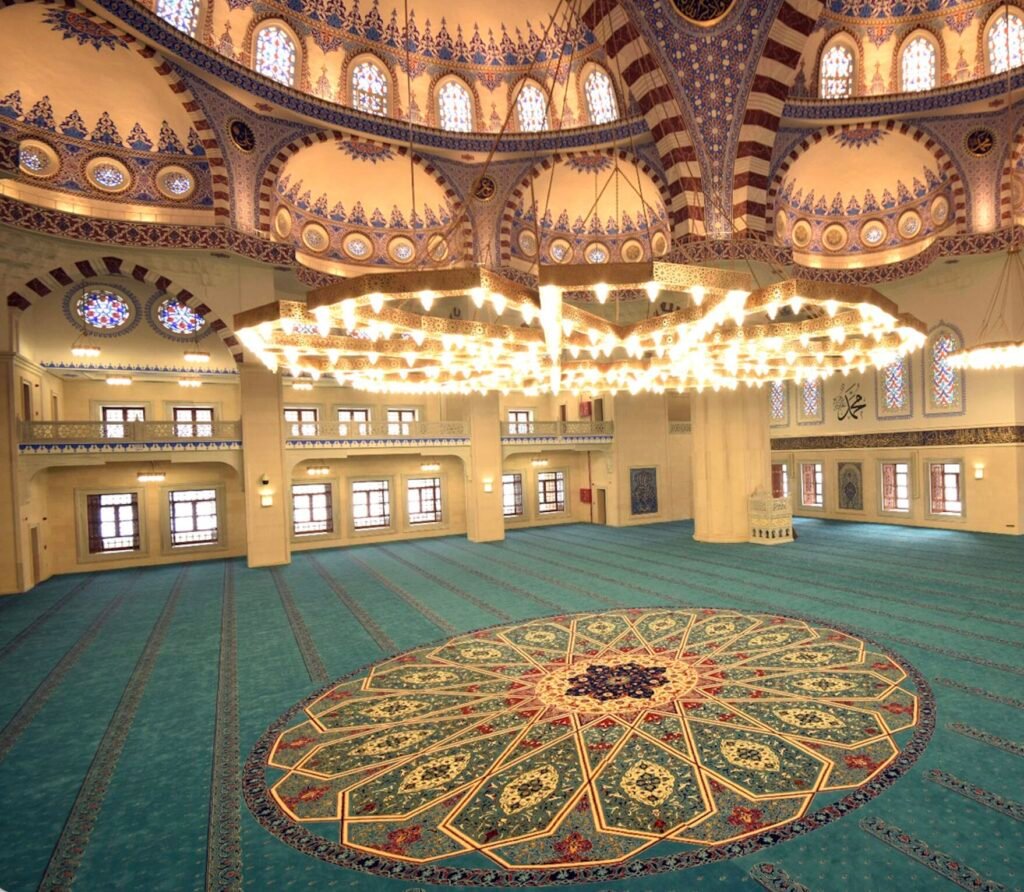
The table gives the short version. The sections below explain each trade-off.
| Design | What you see on the floor | Usually suits | Plan carefully for |
|---|---|---|---|
| Saff row | Repeating bands across the hall, one band per prayer row | Long or wide rectangular halls, halls with many columns, rooms that may be extended later | Can look understated under a large decorated dome |
| Center medallion | One large central motif, with the prayer rows running through the field around it | Square or nearly square halls with a central dome or main chandelier | A dome that is not centered over the prayer floor; columns inside the motif |
| Prayer arch | An arch over each individual prayer place, repeated along every row | Smaller halls, women’s prayer areas and prayer rooms where clearly defined places help | Hall widths that leave part of a place at the side walls; columns standing inside a place |
Whichever design you pick, it is drawn over the same grid. On a MosqueOne carpet each prayer row is 52 in (133 cm) deep and each prayer place is 27 in (68 cm) wide, which works out to about 9.7 sq ft (0.9 m²) of carpet per worshiper. The design only decides how visible that grid is: a row design shows the rows, an arch design shows every single place, and a medallion design lets the rows sit quietly inside a larger picture.
Because the grid comes first, fix the row direction and the number of rows before the committee starts debating motifs. Our guide to saff row spacing explains why rows are this deep and how many fit a given hall depth, and the mosque carpet calculator turns your hall size into rows, places, capacity and an estimated cost by yarn.
A row design is the most practical layout for congregational prayer. Each band marks one row, so worshipers can see where to stand from anywhere in the hall, and late arrivals simply fill the next band.
It is usually the strongest choice when:
The trade-off is visual. Under a richly decorated dome, plain bands can feel modest. One way to add richness without losing the rows is a decorated border along the walls, or a field motif inside each band, instead of switching the whole hall to a medallion.
A medallion carpet is organized around one dominant, symmetrical centerpiece. Britannica’s entry on medallion carpets notes that classic Ottoman and Egyptian examples often use a lobed circle at the center with quarter medallions in the corners. In a mosque, the medallion usually sits under the main dome or chandelier, so the floor answers the ceiling. The Sheikh Zayed Grand Mosque in Abu Dhabi is a well-known example: the official description of its main prayer hall carpet explains that most of the medallions are placed beneath the chandeliers, while raised prayer lines run across the whole floor.
A medallion is a good fit when:
Watch two things. First, check that the center of the dome and the center of the carpeted prayer area really are the same point. If the hall extends further behind the dome than in front of it, a medallion placed under the dome will sit off-center on the carpet. That can look right from the entrance and odd from the mihrab, or the other way around, so judge it on photos of your own hall rather than on a drawing. Second, the rows still have to read clearly through the motif. A medallion that swallows the row lines makes it harder to straighten the saff on a crowded Friday.
A prayer-arch design repeats a small arch over each place, so every worshiper has a defined spot facing the qibla. The idea is old. Individual prayer rugs with a niche design, like this 19th-century Anatolian prayer rug at the Metropolitan Museum of Art, use the arch to recall the mihrab. A masjid carpet with prayer arches repeats that niche across the whole hall.
Arches help most where even spacing matters and the room is a manageable size: smaller prayer halls, women’s prayer areas, prayer rooms in schools or workplaces, and halls that also host children’s classes. Each person can see exactly where one place ends and the next begins. In a very large main hall, hundreds of identical arches can feel busy, so a committee may decide to keep arches for the smaller rooms and use rows or a medallion in the main hall.
Because every arch is a fixed 27 in (68 cm) wide, the hall width rarely divides into whole places. Take a hall 70 ft (21.34 m) wide. Thirty-one places use about 69 ft 2 in (21.08 m), which leaves roughly 10 in (26 cm). With a row design nobody notices. With arches, a cut-off arch at one wall is visible from every row. Ask for the arch grid to be centered on the mihrab, so the place in front of the imam is whole and any leftover width falls equally at the two side walls, where a border can take it up. Do the same exercise for columns: mark them on the plan and see whether one lands in the middle of a place.
Before you look at patterns, walk the hall with this checklist. Each answer points toward one of the three designs.
Each of our custom mosque carpets for the USA and Canada is made to measure for one prayer hall and woven for it, rather than cut from stock rolls and pieced together. That is what makes the layouts above workable: a medallion can be planned around your dome and a border around your walls. Colors and motifs can also be customized to suit the architecture.
Before production, we place the chosen design onto photos of your own prayer hall, so the committee can approve it in the real space. To get the most from that preview:
A choice this visible usually needs the whole board to agree, and a picture of your own prayer hall carpet settles more debates than a sample book.
Yes. A center-medallion design keeps the prayer rows built into the field around the motif, so the hall gets a focal point and worshipers still have clear lines to stand on.
Our list prices are set by yarn and weight: polypropylene $0.93–1.39 per sq ft ($10–15/m²), acrylic $1.58–4.37 per sq ft ($17–47/m²), wool $4.18–5.11 per sq ft ($45–55/m²) and New Zealand wool $6.04 per sq ft ($65/m²). Prices are ex-works from our factory in Demirci, Manisa, Turkey; shipping, import duties and installation are extra, and the written quote confirms the price for your chosen design. For a main prayer hall, our wool mosque carpet is the premium, longest-lasting option.
It doesn’t have to. Each area is made to measure, so a women’s hall can share the main hall’s colors and motifs while using a layout that suits its own shape, such as prayer arches in a smaller room.
The design is approved before production starts. From order to delivery, allow 8 to 12 weeks: 4 to 6 weeks of production and 4 to 6 weeks of delivery. The minimum order is about 2,153 sq ft (200 m²); if your hall is smaller, ask us.
Ready to compare designs on your own floor plan? Request a free mosque carpet quote with your hall measurements and a few photos, and tell us which layouts you are considering. Installation can be arranged; ask us about your location.