Good mosque carpet cleaning comes down to four habits: keep soil out at the doors, vacuum each part of the hall as often as its traffic demands, treat spills the same day, and book deep cleaning before the carpet starts to look tired rather than after. Skip them, and grit and oily soil wear a prayer hall carpet down long before its design fades.
A masjid is not an office, though, and generic carpet advice misses what makes it different: worshipers in socks or bare feet, many coming straight from wudu; foreheads and palms on the carpet in sujood; large congregations on Fridays, through Ramadan and at Eid; and food on the floor at iftar. This guide turns published carpet-industry guidance into a plan a mosque committee can use: a zone map, a schedule, a spill routine, notes for wool, acrylic and polypropylene, and questions to ask a cleaning contractor.
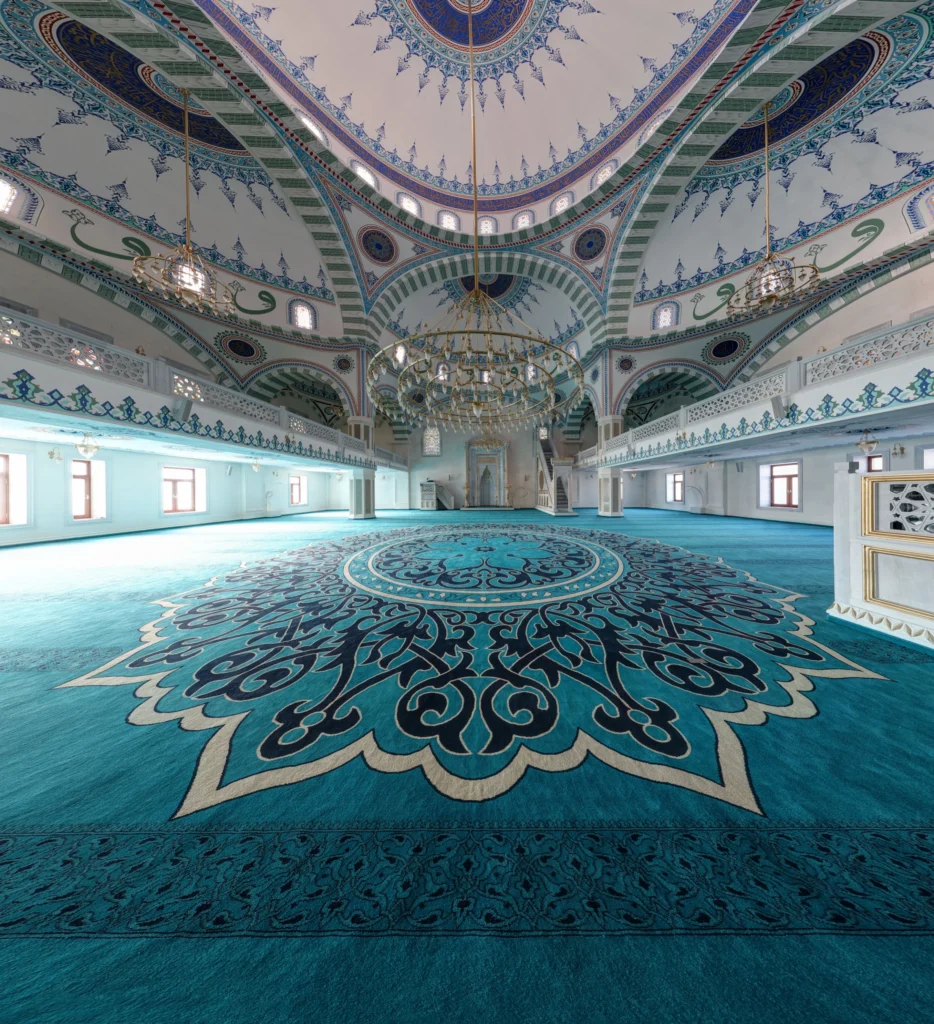
Because shoes stay outside, a mosque carpet collects less sand and grit than the carpet in a school or a shop. What it gets instead is fine, sticky soil: skin oils, hair oil and attar (perfume oil) carried on hands and feet, damp socks after wudu, and dust drifting in from the shoe area. The WoolSafe Organisation’s soiling-prevention advice separates coarse, dry soil, which a vacuum removes, from fine, oily soil that clings to the fibers and needs a cleaning solution to release it.
Wear is uneven, too. The strip just inside each door, the route from the shoe racks to the front, and the first rows behind the imam take most of the traffic, while back rows and galleries may only fill for Jumu’ah and Eid. Ramadan adds nightly taraweeh crowds and, where iftar is served in the hall, food on the carpet itself.
One thing this guide does not cover is ritual purity. If something impure (najis) reaches the carpet, follow your imam’s guidance on how to purify it. The steps below are about protecting the fibers and the look of the carpet.
Commercial carpet programs start by sorting a floor into traffic levels and then cleaning each level at its own pace. The Carpet and Rug Institute (CRI), the US carpet industry’s trade association, sums up the basic rule in its cleaning and maintenance guidance: vacuum high-traffic areas daily, medium-traffic areas twice a week and light-traffic areas weekly. In most mosques the zones fall like this:
| Zone | Where it is in a mosque | Traffic level |
|---|---|---|
| Entry strips | The first few feet inside each prayer-hall door, and the carpet edge next to shoe racks or the wudu area | Heavy to extra heavy |
| Walkways | Routes from the doors to the front rows, around columns and toward the minbar | Heavy |
| Daily rows | The front saff rows that fill at all five daily prayers | Moderate to heavy |
| Weekly rows | Back rows, galleries and overflow areas used mainly for Jumu’ah and Eid | Light |
| Multi-use areas | Carpet used for iftar, community dinners, classes or children’s programs | Extra heavy during those events |
Mark the zones on a copy of your floor plan and pin it in the cleaning cupboard. Volunteers then know where the daily vacuum matters most, and a contractor can price the walkways and the full hall separately.
US carpet maker Shaw publishes a frequency chart for commercial carpet in the maintenance checklist for its Philadelphia Commercial line. The table applies those frequencies to the mosque zones above. Treat it as a starting point and tighten it wherever your hall shows soil sooner.
| Traffic level (mosque zones) | Vacuum | Interim clean | Deep clean (hot water extraction) |
|---|---|---|---|
| Light (weekly rows, galleries) | 2+ times a week | As needed | Once a year |
| Moderate (daily rows) | Daily | As needed | Twice a year |
| Heavy (entry strips, walkways) | At least daily | Monthly | 4 times a year |
| Extra heavy (iftar areas, entrances in snow and slush) | At least daily | Weekly | Monthly |
Spots and spills are handled the same day in every zone. The interim clean is a low-moisture method, usually encapsulation, that lifts surface soil between deep cleans. Shaw suggests a hot water extraction after every third encapsulation and does not recommend bonnet cleaning on its carpets. CRI’s advice for heavy and severe traffic areas is stricter still: weekly interim cleaning, deep cleaning monthly where traffic is severe and quarterly where it is heavy, and a pile lifter once a month.
Fresh spills come out far more easily than old ones, so speed matters more than the product. Keep a small spill kit where volunteers can find it: plain white cotton cloths, a spot cleaner certified under CRI’s Seal of Approval (one marked WoolSafe Approved for wool carpets), a solvent gel for oily marks, a spoon or scraper, a spray bottle of clean water and, if the budget allows, a small hand extractor. Then:
The routine above suits all three yarns we weave. Each has a few points of its own.
Wool is the most resilient of the three yarns, which is why our wool mosque carpet is the premium choice for main prayer halls in daily use.
Acrylic is soft and wool-like, holds vivid colors and has an anti-bacterial finish. That finish is not a substitute for cleaning: vacuum and spot-clean acrylic on the same schedule as any other carpet in its zone, and use products certified for carpet. Before applying a disinfectant, read the question on disinfectants below.
Polypropylene is the most economical yarn, easy to clean and low in dust, and it does not absorb moisture, which makes it a sensible choice for basement halls, overflow rooms and multi-use areas. Its weak point is oil. A polypropylene care sheet from flooring maker Curran describes the fiber as attracting oily soil, and notes that cleaning solution the fiber does not absorb can sink into the backing and later wick back as brown or yellow marks. In practice:
Our polypropylene mosque carpet page lists its weights and current prices.
Volunteers can keep up with vacuuming and spots, but deep cleaning is a job for a contractor with the right equipment. Before you book one, ask:
A prayer hall carpet is one of the largest single purchases a mosque makes. Take a 66 × 48 ft hall: 3,168 sq ft, or about 294 m². At our current ex-works prices, new carpet for it costs about $3,530 in polypropylene of 2.0 kg/m² (59 oz/yd²), $9,710 in acrylic of 3.5 kg/m² (103 oz/yd²) and $14,720 in wool at $4.65 per sq ft ($50 per m²), the middle of our $4.18–5.11 per sq ft ($45–55 per m²) wool range. Shipping, import duties and installation come on top. The mosque carpet cost guide explains how these prices are built, and the mosque carpet calculator estimates area, rows and budget for your own hall.
Replacement also takes time. A made-to-measure carpet needs 4–6 weeks of production plus 4–6 weeks of delivery, so 8–12 weeks from order to delivery. If the carpet in your walkways is already worn through, start planning months before Ramadan, not weeks.
It depends on the zone. Shaw’s chart runs from once a year in light-traffic areas to monthly in extra-heavy areas such as iftar zones, and CRI’s general advice is a professional deep clean every 12 to 18 months. In practice, most halls need the walkways and entry strips deep cleaned several times a year and the whole carpet once or twice, with one clean timed before Ramadan.
Blot or extract as much as you can at once, rinse with cool water and extract again. Don’t use a steam cleaner or any heat: CRI notes that heat sets both the stain and the odor. For how to purify the spot, follow your imam’s guidance.
Be careful. Shaw warns that some disinfectants, including quaternary ammonium compounds, can stain, discolor and damage carpet when used over time, and it advises pH-neutral products only. Regular vacuuming and extraction remove the soil itself. If you still want to disinfect, ask the product’s maker whether it is safe on carpet, and test it in a hidden corner first.
If your carpet is past saving, we weave made-to-measure mosque carpets in wool, acrylic and polypropylene, with prayer rows aligned to the mihrab, 52 in (133 cm) deep and 27 in (68 cm) wide per prayer place. Read our guide to custom masjid carpets, then send your hall measurements through the free quote form.