There are three main ways to buy a mosque carpet in the USA: from a seller that keeps prayer-row carpet in stock in a US warehouse, through a local flooring contractor, or made to measure directly by a manufacturer abroad, for example in Turkey. Stock carpet arrives fastest. A made-to-measure carpet takes longer, but it is woven for your own hall, with the prayer rows parallel to the qibla wall, so the installer doesn’t have to bend standard rows to fit the room.
MosqueOne weaves made-to-measure mosque carpets in its own factory in Demirci, Manisa, Turkey, and ships to mosques in the USA and Canada. This guide shows how US committees compare the three routes, how to size a prayer hall in square feet, and what to settle with a customs broker and the local fire marshal before anyone signs. Where it helps, we use our own prices and lead times as a benchmark.
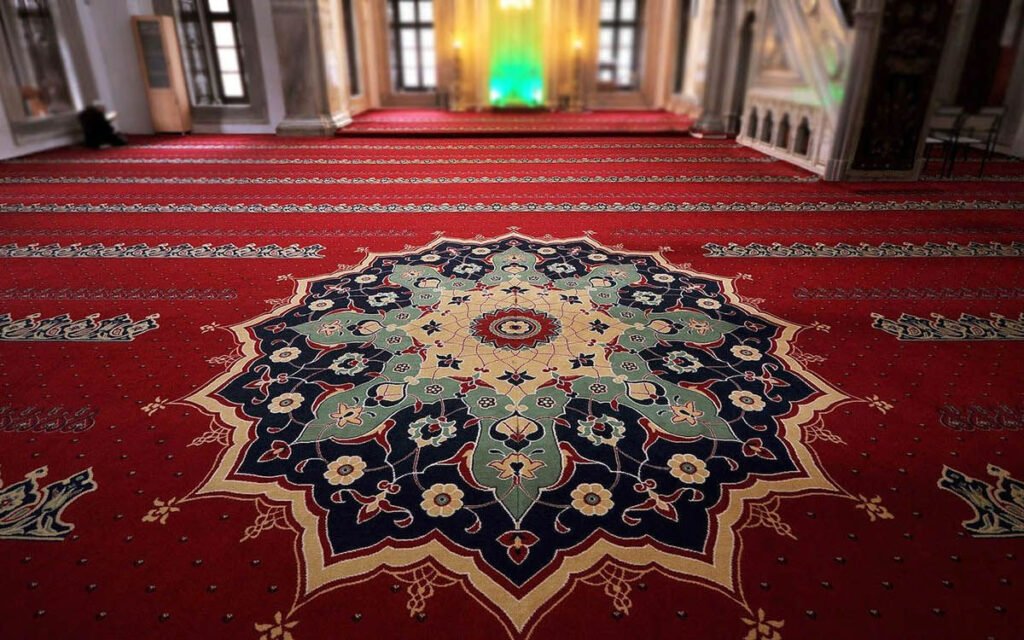
Each route suits a different kind of project. The table compares them on the points committees usually debate: fit, prayer rows, timing and who deals with customs.
| Route | What you get | Prayer rows and qibla | Timing | Who handles import | Usually suits |
|---|---|---|---|---|---|
| Prayer-row carpet from US stock | Standard rolls in set widths and patterns, cut and seamed on site | The rows are part of the roll. If your walls don’t face the qibla, the rolls are laid at an angle, which means more cutting, more seams and more waste. | Usually the quickest; ask the seller what is in stock and when it can ship | The seller | Rented rooms, small musallas and urgent openings |
| Local flooring contractor | One contract for supply and fitting, with carpet from the contractor’s own suppliers | Depends on the product: plain commercial carpet has no rows at all, and prayer-row rolls have the same limits as stock carpet. | Depends on the contractor’s supplier | The contractor or their supplier | Committees that want a single local point of contact |
| Made to measure from a factory | A carpet woven to your hall plan, with the design laid out from the mihrab | Rows are woven parallel to the qibla wall and centered on the mihrab, whatever angle the building sits at. | At MosqueOne, 8–12 weeks from order to delivery (4–6 weeks of production plus 4–6 weeks of delivery) | With an ex-works price, your mosque, usually through a customs broker | Purchased and purpose-built Islamic centers with halls of about 2,153 sq ft (200 m²) or more, our minimum order |
When you collect quotes, compare them on the same basis: the price per square foot for a named yarn and weight, what the price includes (freight, duties, installation, underlay), and the date the carpet will be on your floor, not just the date it leaves a warehouse or a factory.
American mosques are growing and moving. The US Mosque Survey counted 2,769 mosques in 2020, a 31% increase from 2,106 in 2010, and two-thirds of all mosques had moved to their present location since 2000, according to ISPU’s report The American Mosque 2020. The same report describes a typical path: a rented space first, then a purchased building with more room, and finally a building built as a mosque. In 2020, 37% of mosques were purpose-built; most are purchased buildings, from former churches to houses.
Where your community stands on that path changes what a sensible carpet purchase looks like.
A lease can end, and a rented room is often small. A 40 × 30 ft room is 1,200 sq ft (about 111 m²): enough for six rows of 17 worshipers, but below our minimum order of about 2,153 sq ft (200 m²). If that is your situation, ask us, and think about whether the carpet could move with you when the lease ends.
This is where the qibla causes the most trouble. A building laid out for its old use rarely has a wall that faces the qibla, so the prayer rows end up at an angle to the walls. Stock rolls with rows in the pattern then have to be cut on a diagonal across the room. A made-to-measure carpet is planned the other way round: the rows are set out from the qibla line and the mihrab first, and the edges are cut to the walls. Confirm the qibla bearing with your imam before anyone measures, and note the fixed features left from the old use, such as platforms, steps and columns. Our quote form has a field for the qibla angle in degrees.
A new mosque is usually designed around the qibla, so the rows run square to the hall. The carpet questions here are design and timing: a center medallion under the dome or a plain grid of prayer rows, and when the order has to be placed so that 8–12 weeks from order to delivery fits before the opening. Bring the carpet into the construction schedule early, because the layout needs the final hall dimensions.
Our carpets use a prayer row 52 in (133 cm) deep and a prayer place 27 in (68 cm) wide, which comes to about 9.7 sq ft (0.9 m²) per worshiper. That figure turns US attendance data into floor area. ISPU’s survey found that Jum’ah attendance averaged 410 people per mosque in 2020, up from 353 in 2010, and that 21% of mosques had started a second or even third Jum’ah service to make room. At 9.7 sq ft per worshiper, 410 people need about 4,000 sq ft (370 m²) of prayer rows, before you add the imam’s area, walkways and space along the walls.
The table shows three US hall sizes with full rows (the qibla wall along the first dimension) and ex-works prices from our current list. Wool is shown at $50 per m² ($4.65 per sq ft), the midpoint of our $45–55 per m² range.
| Hall | Area | Rows × places | Worshipers | Polypropylene 2.0 kg/m² ($1.11/sq ft) | Acrylic 3.5 kg/m² ($3.07/sq ft) | Wool ($4.65/sq ft) |
|---|---|---|---|---|---|---|
| Rented room, 40 × 30 ft | 1,200 sq ft (111 m²) | 6 × 17 | 102 | Below our minimum order: ask us | ||
| Converted building, 62 × 38 ft | 2,356 sq ft (219 m²) | 8 × 27 | 216 | about $2,630 | about $7,220 | about $10,940 |
| Purpose-built hall, 96 × 64 ft | 6,144 sq ft (571 m²) | 14 × 43 | 602 | about $6,850 | about $18,840 | about $28,540 |
New Zealand wool is $65 per m² ($6.04 per sq ft), about $14,230 for the 62 × 38 ft hall. Optional underlay adds $0.56 per sq ft for felt or $1.30 per sq ft for rubber. Prices are ex-works at our factory in Turkey; shipping, import duties and installation are extra, and the written quote confirms the price. If the rows have to run at an angle to the walls, fewer full places usually fit, and the layout drawing shows the real count. To try your own dimensions, use our mosque carpet calculator for area, rows and cost, and read how to measure a prayer hall and its qibla angle before you send figures to any supplier.
With an ex-works price, the carpet becomes your shipment at the factory gate, so the US side of the journey needs an owner on your committee. Our guide to buying from mosque carpet manufacturers in Turkey explains delivery terms such as EXW, DAP and DDP. On the US side, plan these steps:
Two sets of rules can apply to a prayer hall carpet in the USA, and both are easier to deal with before the order than after delivery.
Here is what we can document. Only our 100% wool carpets, including New Zealand wool, are flame-retardancy tested; our acrylic and polypropylene carpets have no flame-retardancy certificate. If your fire official, insurer or broker asks for fire documentation, choose a 100% wool mosque carpet, ask us about its flame-retardancy test before you order, and let them confirm whether it covers what they require. All our yarns carry OEKO-TEX® Standard 100 and ISO 9001.
A complete first message avoids rounds of follow-up questions. Send:
Yes. Prayer-row carpet is sold from US stock and usually ships faster than a made-to-measure carpet. Check how the rows will sit against your qibla wall first: if the walls don’t face the qibla, stock rolls have to be laid at an angle, which a carpet woven to your hall avoids.
At MosqueOne, 8–12 weeks from order to delivery: 4–6 weeks of production and 4–6 weeks of delivery. Leave extra time for customs clearance and installation, and order earlier if you are aiming for Ramadan, Eid or an opening date.
Yes. Our list prices are in US dollars, ex-works at our factory in Turkey, from $0.93 per sq ft for polypropylene to $6.04 per sq ft for New Zealand wool. Shipping, import duties and installation are extra, and the written quote confirms the price.
Installation can be arranged; ask us about your location.
Our minimum order is 200 m², about 2,153 sq ft, which is roughly 220 prayer places. For smaller rooms, ask us.
Ready to compare options? Send your hall dimensions in feet, the qibla angle and a few photos through our free mosque carpet quote form, and we’ll come back with a written quote in US dollars. For background on yarns, designs and prices, see our complete guide to mosque carpets.