To choose among mosque carpet manufacturers in Turkey, work with a factory that weaves to your prayer hall’s measurements, ask to see the design placed on photos of your own hall, and get the yarn, weight, price per square foot, minimum order, lead time and delivery term in writing before you pay anything. Then plan freight and customs early: with an ex-works price, your committee or the customs broker you hire takes over at the factory.
Turkey is an obvious place to look. In the first nine months of 2026, Turkish carpet exporters shipped $2.017 billion of carpets to 186 countries and free zones, and the United States was their largest single market, according to Hürriyet Daily News on 2026 Turkish carpet exports. MosqueOne weaves made-to-measure mosque carpets in its own factory in Demirci, Manisa, Turkey, and ships to mosques in the USA and Canada. This guide covers what to check with any Turkish supplier and, where it helps, gives our own figures as a benchmark.
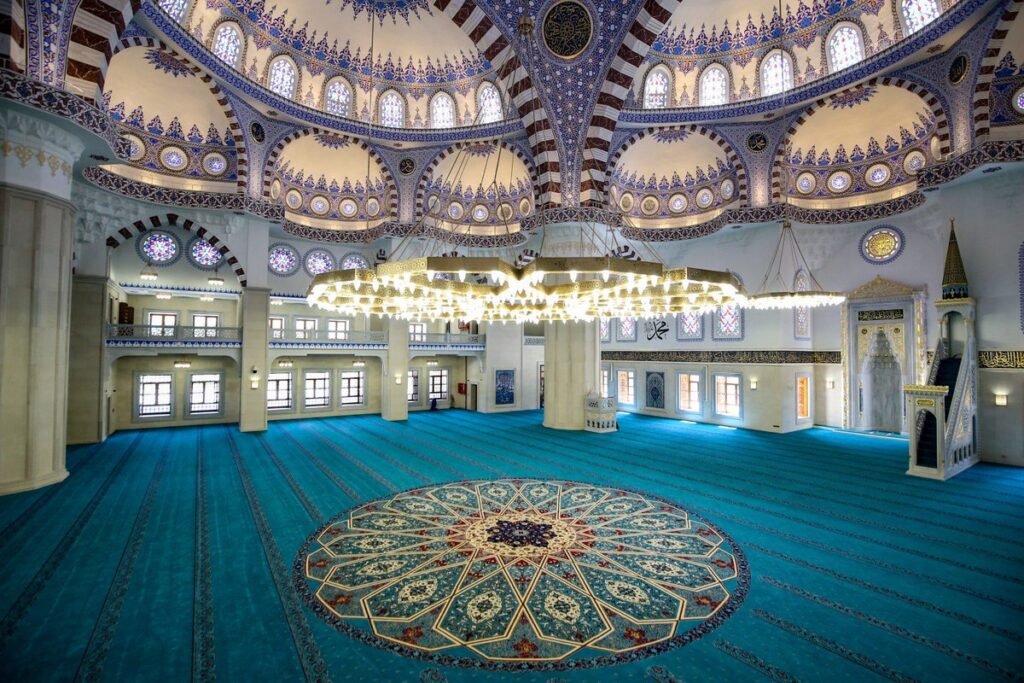
Carpet is a large export industry in Turkey, and most of it is factory production: machine-made carpets accounted for $1.56 billion of the $2.017 billion exported in the first nine months of 2026, well ahead of tufted and handmade carpets (same Hürriyet report). In practice, a committee in Houston or Toronto is buying from an industry that ships carpet abroad every day.
Within that industry, one town keeps coming up in mosque projects. Demirci, a district of Manisa province in western Turkey, is a long-established carpet-weaving town whose looms supply well-known mosques at home and abroad. In February 2026, Hürriyet Daily News reported that a new carpet for the Selimiye Mosque in Edirne, made of 100 percent domestic wool, was woven in Demirci. The same month, Daily Sabah reported that the 8,600 sq ft (800 m²) carpet laid in the Tokyo Mosque in Japan was produced in Demirci as well. MosqueOne’s factory is in the same town.
When people picture a “Turkish carpet,” they often imagine a hand-knotted rug. For a mosque, the two routes lead to very different projects. According to Daily Sabah, the Tokyo Mosque carpet was crafted entirely by hand and took about 18 months to complete. That pace suits a landmark building that plans a restoration years ahead and wants a piece tied to its history.
Most Islamic centers in the USA and Canada need something else: a wall-to-wall prayer hall carpet woven to the room’s exact size, with straight prayer rows, at a price per square foot a community can fund, and installed within a season. That is the job of a made-to-measure factory carpet. At MosqueOne, it arrives 8–12 weeks after the order.
Before you compare prices, ask every supplier one plain question: is this carpet hand-knotted, or woven in a factory? Quotes for the two are not comparable.
Not every company that sells Turkish mosque carpets weaves them. Buying through a trading company is not wrong in itself, but you should know who controls the loom, because that is who can correct a layout, match a color or move your order up the schedule. Four checks tell you a lot:
Send the same questions to every supplier, so that the answers line up. The right-hand column gives MosqueOne’s answers as a benchmark.
| Question | Why it matters | MosqueOne’s answer |
|---|---|---|
| Do you weave in your own factory? | You want the company that controls production. | Yes: our factory in Demirci, Manisa, Turkey. Head office in Leipzig, Germany. |
| Is the carpet woven to our hall’s measurements? | Carpet cut from stock rolls and pieced together may not line up with your qibla wall. | Yes. Every carpet is made to measure, with prayer rows aligned to the mihrab and parallel to the qibla wall. |
| What row depth and prayer-place width do you use? | These two numbers decide how many worshipers fit. | Rows 52 in (133 cm) deep, places 27 in (68 cm) wide: about 9.7 sq ft (0.9 m²) per worshiper. |
| Can we see the design in our own hall before production? | Committee members approve faster when they can see the result. | Yes. We place the chosen design onto photos of your prayer hall for approval. |
| Which yarn, weight and pile height, at what price per square foot? | Prices only compare when yarn and weight match. | Polypropylene $0.93–1.39, acrylic $1.58–4.37, wool $4.18–5.11 and New Zealand wool $6.04 per sq ft, ex-works. |
| Which certificates cover the carpet you are quoting? | Your fire official, insurer or funder may ask for documents. | OEKO-TEX® Standard 100 and ISO 9001 for all yarns. Only our 100% wool carpets are flame-retardancy tested; acrylic and polypropylene carpets have no flame-retardancy certificate. |
| What is the minimum order? | Small halls may fall below it. | About 2,153 sq ft (200 m²). For smaller rooms, ask us. |
| How long from order to delivery? | Openings, Ramadan and Eid are fixed dates. | 8–12 weeks: 4–6 weeks of production plus 4–6 weeks of delivery. |
| What does the price include? | Freight, duties and installation can change the total a lot. | List prices are ex-works at our factory in Turkey. Shipping, import duties and installation are extra, and the written quote confirms the price. |
| Can you install it? | Someone has to lay the rows exactly where the drawing puts them. | Installation can be arranged; ask us about your location. |
Whichever supplier you choose, also get the warranty, the payment schedule and the roll width in writing. These differ from one supplier to the next; for ours, ask us.
Every international quote rests on a delivery term, usually one of the eleven Incoterms® 2020 rules of the International Chamber of Commerce. The term decides who books the ship, who carries the risk while the carpet is at sea, and who clears customs. The ICC Academy explains the difference between EXW and DDP and the difference between C and D rules. For a carpet order, it works out like this:
| Term | Main freight booked and paid by | Risk passes to you | Import formalities in the USA or Canada |
|---|---|---|---|
| EXW (Ex Works) | You, from the factory onward, including loading and export formalities | At the seller’s premises | You |
| CIF or CIP | The seller, to the named destination | At shipment, not on arrival | You |
| DAP (Delivered at Place) | The seller | At the named destination, ready for unloading | You |
| DDP (Delivered Duty Paid) | The seller | At the named destination | The seller, where local rules let a foreign company do it |
Two points catch committees out. Under CIF or CIP, the seller pays the freight and buys insurance, but the risk is already yours once the goods are shipped, so check what that insurance covers. Under DDP, the ICC Academy notes that some countries don’t allow foreign entities to carry out import formalities, and in that case its comparison of DAP and DDP points to DAP instead.
MosqueOne’s list prices are ex-works at our factory in Turkey, so freight, insurance and import costs sit outside the carpet price. Ask us about shipping to your city, and compare suppliers on the same term.
Under ex-works, DAP or a C term, your mosque is the importer, usually working through a customs broker. Start these steps early.
In either country, ask your local fire marshal or building official early which documents they need for the prayer hall floor covering. Only our 100% wool carpets are flame-retardancy tested; acrylic and polypropylene carpets have no flame-retardancy certificate. If your project needs that document, look at our 100% wool mosque carpet and share the official’s answer with us before you order.
Counting backwards, a carpet you want down before Ramadan should be ordered about three months ahead, plus the weeks your committee needs to measure, compare quotes and approve the design.
An ex-works price is only the first line of the budget. Take an 80 × 55 ft prayer hall: 4,400 sq ft, or about 409 m². With rows 52 in deep and places 27 in wide, its full depth holds up to 12 rows of 35 worshipers. At our current list prices, the carpet alone comes to about:
Optional underlay adds about $2,450 for felt or $5,720 for rubber. To compare suppliers fairly, add the same items to each quote: ocean freight and insurance, export and import paperwork, customs broker fees, any duties, trucking from the port and installation. A lower ex-works carpet price can end up level with a higher DAP quote once those are in. Our mosque carpet calculator works out the area, rows and carpet cost for your own hall size.
It can be, but compare landed cost rather than the factory price. Add freight, insurance, broker fees, any duties and installation to every quote, and make sure each supplier is pricing the same area, yarn and weight.
With MosqueOne, 8–12 weeks from order to delivery: 4–6 weeks of production and 4–6 weeks of delivery. Allow extra time before the order for measuring, quotes and design approval, and after it for installation.
You do. Under ex-works the buyer is responsible from the factory onward, including export formalities in Turkey, the freight and import clearance at home, usually with help from a freight forwarder and a licensed customs broker.
At MosqueOne it is about 2,153 sq ft (200 m²), or roughly 220 prayer places of 27 × 52 in. For a smaller prayer room, ask us.
Yes. Custom colors and motifs are available, and you approve the design on photos of your own prayer hall before production starts.
Planning a new prayer hall carpet? Send us the hall’s length and width, and the qibla direction if you have it, through our free mosque carpet quote form, or write to info@mosqueone.com. We reply with a written quote, and once you pick a design, we show it on photos of your own hall before anything is woven. For yarns, rows and layouts in more depth, start from our main guide to masjid carpets.