To measure a mosque for carpet you need more than the length and width of the room. A made-to-measure prayer hall carpet is planned around the qibla line, the number of saff rows and every column, niche and doorway that breaks up the floor. Get those right on paper and the carpet arrives woven for your hall, with rows that run straight from wall to wall.
This guide takes your committee through the site visit in the right order: the tools to bring, what to measure first, how to turn the numbers into rows and prayer places, and what to send so you get an accurate quote. A worked example and a blank worksheet are included.
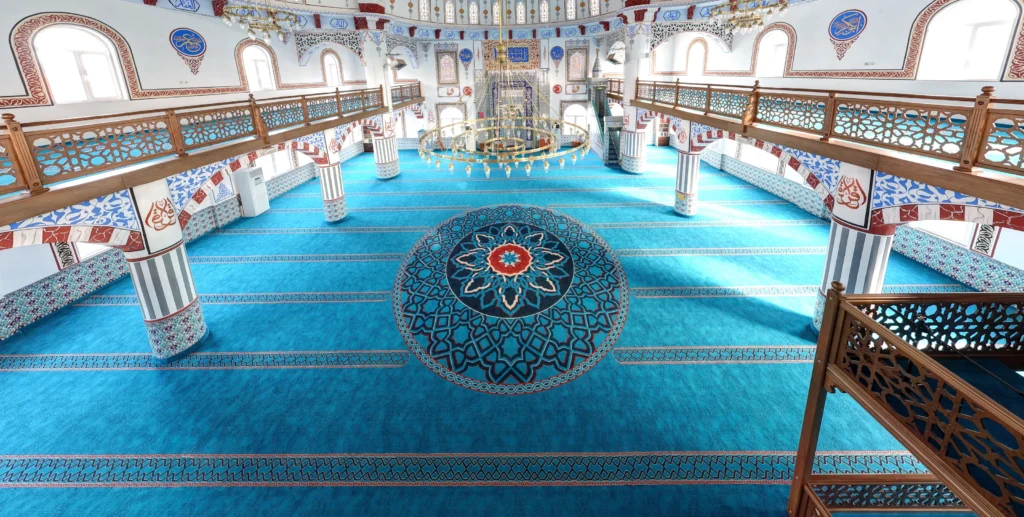
Every prayer row runs parallel to the qibla, so the qibla line is the reference for the whole layout. In most purpose-built mosques the qibla wall already faces the right direction and the rows simply follow the walls. In converted buildings, such as a former warehouse, office or shop, the qibla often sits at an angle to the walls.
The direction itself is for your imam and mosque leadership to confirm; the carpet is laid to match what they decide. If someone checks it with a compass or a phone, remember that a magnetic needle points to magnetic north, not true north. Across the USA and Canada that gap, called magnetic declination, changes from city to city and can be many degrees. NOAA’s free magnetic declination calculator gives the correction for your address.
Once the line is agreed, mark it on the floor with tape. Then measure how far the line sits from the qibla wall at two points several yards apart; from those two distances the angle between the line and the wall can be worked out exactly. Send that information with your measurements, because the row plan is drawn from the qibla line, not from the walls.
Cut-outs cause more measuring mistakes than anything else. For every column, record whether it is square or round, its size, and the distance from the qibla wall and the left wall to its nearest face. Always measure from the same two walls, so every feature can be plotted on one drawing without guesswork.
The mihrab niche needs its own set of numbers: the opening width, the depth and whether the floor inside is level with the hall. Some committees carpet the niche with a matching piece; others keep it as stone or tile. Decide this before ordering, and do the same for the minbar steps and any platform.
Also note whether a column stands inside a prayer row. A column in a row costs one or two prayer places, and knowing where that happens lets the pattern be planned around it rather than cut through it. Some communities prefer not to form rows between columns at all, so ask your imam how those spots should be treated before the layout is drawn.
MosqueOne carpets use a saff row depth of 52 in (133 cm) and a prayer place 27 in (68 cm) wide, which is about 9.7 sq ft (0.9 m²) per worshiper. With those two numbers you can estimate capacity before you request a quote:
Usable depth is the hall depth minus the space kept in front of the first row for the imam and any walkway at the back. Agree both with your imam first; as the example shows, a few inches can change the result.
The qibla wall is 64 ft (19.51 m) long and the hall is 46 ft (14.02 m) deep, giving 2,944 sq ft (273.5 m²) of floor. The committee compares two layouts with a 3 ft (0.91 m) walkway at the back.
| Layout | Option A | Option B |
|---|---|---|
| Space in front of the first row | 4 ft (1.22 m) | 3 ft 8 in (1.12 m) |
| Usable depth | 39 ft (11.89 m) | 39 ft 4 in (11.99 m) |
| Full rows at 52 in (133 cm) | 8 | 9 |
| Places per row at 27 in (68 cm) | 28 | 28 |
| Capacity | 224 worshipers | 252 worshipers |
Taking 4 in (10 cm) off the front strip adds a ninth row and 28 more places. That is why exact numbers matter more than rounded ones, and why the row plan should be settled before the carpet is woven.
As a first budget check, that 273.5 m² floor comes to roughly $3,280 in 2 kg/m² polypropylene, $8,480 in 3.2 kg/m² acrylic or $13,680 in wool at $50/m² (the middle of the wool range). These are ex-works list prices; shipping, import duties and installation are extra, and the written quote confirms the final figure. Our mosque carpet cost guide breaks down every price tier.
Print this table and fill in both columns, or just the one you measured in.
| # | Measurement | How to take it | ft / in | m / cm |
|---|---|---|---|---|
| 1 | Width at the qibla wall | Along the qibla wall, at floor level | ||
| 2 | Width at the back wall | Along the back wall, at floor level | ||
| 3 | Depth, left side | Qibla wall to back wall | ||
| 4 | Depth, right side | Qibla wall to back wall | ||
| 5 | Diagonals A and B | Corner to opposite corner, both ways | ||
| 6 | Qibla line position | Distance from the qibla wall at two marked points | ||
| 7 | Mihrab niche | Opening width × depth; floor level or raised? | ||
| 8 | Columns (one line each) | Size; distance to the qibla wall and the left wall | ||
| 9 | Doors | Width, swing direction, threshold height | ||
| 10 | Fixed obstacles | Minbar, platforms, vents, floor outlets | ||
| 11 | Dome or chandelier center | Distance to the qibla wall and the left wall | ||
| 12 | Front strip and back walkway | As agreed with your imam | ||
| 13 | Other areas | Women’s hall, mezzanine, overflow rooms: one worksheet per room |
Send the completed worksheet, a simple sketch of the hall (hand-drawn is fine), the photos, and three preferences: the design family (center-medallion, prayer-row or prayer-arch), the yarn and whether you want an underlay (felt or rubber). If you have not chosen a yarn yet, compare the wool mosque carpet, the most resilient option, with the softer, mid-priced acrylic mosque carpet.
With those details we prepare the quote and the layout. Before production, the chosen design is placed onto the photos of your own prayer hall, so the committee can approve the rows, colors and borders in the real space. Production takes 4–6 weeks and delivery another 4–6 weeks, so allow 8–12 weeks from order to delivery. The minimum order is 200 m² (about 2,153 sq ft). Installation can be arranged; ask us about your location.
Once you have the measurements, enter them in our mosque carpet calculator to see the rows, worshiper capacity and cost by yarn for your hall.
Measure wall to wall and mark the prayer area inside it. Most halls are carpeted edge to edge, but knowing both tells us where rows start and stop and where plain borders belong.
Send the agreed qibla line as two distances from the qibla wall, plus the photos. The row layout is drawn from that line, and the quote explains how it meets your walls.
To the nearest inch (2–3 cm) is enough for a quote. Measure each dimension twice, and use the same two walls as your reference for every column and fixture.
The minimum order is 200 m², about 2,153 sq ft. If your hall is smaller, or you want to combine a main hall and a women’s hall, ask us.
After the order is confirmed, production takes 4–6 weeks and delivery 4–6 weeks. Measure at least three months before the date you need the carpet in place, so there is time for the quote and the design approval as well.
Ready to start? Print the worksheet, book an hour with two volunteers, and send us your measurements for a free quote. If your committee is still comparing options, our guide to made-to-measure mosque carpets for the USA and Canada covers designs, yarns and certifications.